
Who Coaches Enterprise Sales Teams on Executive Level Presentations And What the Right Coach Actually Changes
- Waqas Bhatti Waqas Bhatti
- 6 minutes ago
- 13 min read

I'm a former Naval Commander and Executive Communication Coach who coaches enterprise sales teams and Account Executives on C-suite pitch delivery, boardroom objection handling, and executive presence under pressure. His HALO System methodology combines military grade stress regulation, C-suite buyer psychology, and live video pitch auditing to transform sales reps into commanding executive peers who close 7-figure deals.
"Your sales team does not lose 7-figure deals in the C-suite because the product is wrong. They lose them because the presenter signals, in the first ninety seconds, that they do not belong in that room." Im a Former Naval Commander & Global Executive Sales Communication Coach

The Real Reason Enterprise Deals Die in the Boardroom
Here is a scenario every Chief Revenue Officer and VP of Sales knows intimately.
Your Account Executive has done everything right. Months of discovery. A beautifully engineered solution. A deck that product and marketing both approved. A champion inside the account who is genuinely excited.
Then the C-suite meeting happens.
The AE opens with three slides of company background. The CFO checks their phone. The CRO asks a pointed question about ROI timeline. The AE over explains. The CEO asks a follow up. The AE hedges. The room temperature drops four degrees. Someone says "we will need to think about this" and a deal that should have closed starts its long, quiet death.
The most common and most damaging mistake is opening the pitch with what the product does instead of what the buyer gains. The first is information. The second is a hook. Leading with impact requires you have done your research and most reps have not done it at the right level.
The product was right. The timing was right. The pricing was competitive.
The presentation was wrong. And nobody had ever coached the AE for that room.
In the boardroom, product knowledge is merely table stakes. The differentiator that secures the second meeting and ultimately the deal is executive presence a complex, trainable competency comprising emotional regulation, strategic acumen, and communication velocity. For enterprises seeking to protect margins and shorten deal cycles, developing this competency is no longer optional. It is a strategic imperative.
This is the gap that enterprise sales presentation coaching closes. Not the product gap. Not the pricing gap. The presence gap.
Who Coaches Enterprise Sales Teams on Executive Level Presentations? Fixing the 3 Real Reasons Reps Fail
Most sales training programs focus on the wrong level of the problem. They teach discovery frameworks, objection scripts, and demo techniques. All of which matter until the deal reaches the boardroom.
At that level, a completely different set of rules applies. And most Enterprise Account Executives have never been trained for them.
Problem 1: Feature Dumping Pitching Products to People Who Think in Portfolios
C-suite decision makers do not think about products. They think about risk, return, and organizational readiness. They are making a decision that affects budget allocation, competitive positioning, and often their own reputations.
Reps bring product walkthroughs to strategic conversations, pitching capabilities while executives are trying to defend margins, absorb supply chain shocks, or reallocate capital. The cheat code to winning that room is not a tighter demo it is sitting inside the target company's latest 10-K filing and earnings transcript, rebuilding your pitch around the five core business drivers the CEO is actually managing: Cash, Profit, Assets, Growth, and People.
When a sales rep walks into a C-suite presentation and leads with features even brilliantly delivered features they have already told the room something critical: "I understand my product. I do not understand your business."
That credibility gap does not close. It compounds.
80% of B2B sales presentations fail not because the product is not good, but because the presentation does not resonate with the audience. Most are feature heavy and seller oriented. They focus on what the product does rather than why it matters to the buyer.

Problem 2: Collapsed Presence Under Pressure The Body That Betrays the Brief
The problem usually starts even before the conversation itself, with how reps carry themselves in the room. Low status signals are subtle but immediately damaging: over explaining, rushing through points, asking permission to lead the conversation. Executives are wired to notice these cues and once they do, the dynamic is set. The damage is often done before the first slide appears.
When a CFO leans forward with a sharp challenge to your assumptions, something happens in most AEs that no amount of product training prepares them for: the nervous system fires, the voice loses steadiness, the answer comes too fast or too slow, and the room reads it as uncertainty.
That is not a confidence problem. It is a nervous system problem. And it is entirely trainable.
In my experience commanding naval vessels, you quickly learn that you cannot show hesitation on the bridge.
The crew watches the commander's face before they assess the situation. C-suite buyers do the same thing. In the first thirty seconds after a hostile question, they are not evaluating your answer they are evaluating whether you belong in that conversation at all. That is why we train the nervous system before we train the narrative."
Problem 3 Boardroom Q&A Collapse—Where Deals Go to Die
Enterprise pitches don't die during the presentation they collapse during Q&A when AEs face sharp CFO challenges, CTO skepticism, or heavy CEO silence.
5 Mistakes That Destroy Executive Credibility:
Defensive responses to hostile questions Over explaining simple answers
weak, hedging language;
slide reading under pressure
Burying core recommendations in fluff
C-suite Q&A tests composure, not product knowledge. Without stress tested simulation training, AEs lose authority in the exact moments that define deal success.
What to Look For in an Enterprise Sales Presentation Coach The Criteria That Actually Matter
Not every executive communication coach is equipped to work with enterprise sales teams on C-suite presentations. The stakes are different. The audience psychology is different. The consequences of failure are measured in deal size and sales cycle length, not just professional reputation.
Here are the criteria that separate a coach who is genuinely equipped for this work from one who is not.
Criterion 1: Military Grade Nervous System Regulation Not Just "Confidence Tips"
The most important and most overlooked qualification in an enterprise sales presentation coach is their ability to train the human nervous system for real pressure.
A standard public speaking coach can help a sales rep feel more comfortable in front of an audience. That is useful for internal presentations and mid level stakeholder meetings.
It is not sufficient for a boardroom with a skeptical CFO, an impatient CEO, and $2 million in annual contract value on the line.
Organizations that effectively train sales reps for executive presence use "war room" simulations that replicate high stakes scenarios, creating controlled stress conditions that allow the nervous system to rehearse composure before the real moment arrives.
My approach comes directly from my background commanding naval vessels in high pressure, high consequence environments. On a ship in degraded conditions, composure is not optional. It is operational. The techniques he developed for maintaining command presence under genuine threat are the same ones he now applies to enterprise sales coaches, adapted for the boardroom, not the bridge.
This is not a metaphor. It is a methodology. And it produces a different caliber of result than any "presentation tips" program can achieve.
Criterion 2: C-Suite Buyer Psychology Understanding What Executives Actually Evaluate
An enterprise sales presentation coach must understand how C-suite decision makers process information, evaluate risk, and form trust judgments because if the coach does not understand the audience, they cannot prepare the presenter for them.
Before the first executive meeting, the strategic buyer is mapping three tiers of evaluation: the economic logic (does this make financial sense at our current business priorities?), the risk exposure (what could go wrong and who would own it?), and the credibility signal (does this person understand our world well enough to trust them with our resources?). AEs who walk in without alignment to all three do not get to a second meeting.
C-suite buyers are not evaluating your product in isolation. They are evaluating the total risk of the decision the risk of buying, the risk of implementing, the risk of being associated with the choice if it goes wrong. A great enterprise sales presentation reframes the purchase not as a cost but as a risk mitigation. Not as a capability but as a competitive protection.
This is the language of business case framing, and it is the most consistently underdeveloped skill I encounter in my coaching work with enterprise sales teams.
Criterion 3: Live Video Pitch Auditing Real Feedback on Real Performance
The gap between how a sales rep thinks they perform in the C-suite and how they actually perform is one of the most consistently surprising discoveries in executive sales coaching.
Most AEs have never watched themselves present to a challenging audience. They have received feedback vague, encouraging, rarely specific. But they have not seen what the room sees: the micro moment of hesitation after a hard question, the voice that rises in pitch when challenged, the eye contact that drops to the slides exactly when it should be holding the CFO's gaze.
Live pitch auditing involves recording actual sales presentations, analyzing delivery against a specific framework, and providing targeted feedback that translates directly into behavioral change in the next real pitch situation.
My coaching methodology includes structured live video audit sessions where AEs present to a simulated C-suite environment, are recorded, and receive frame-level feedback on the specific moments that are winning or losing the room.
This is not a one time exercise. It is a repeated, progressive process because the gap between awareness and automaticity requires multiple iterations under realistic pressure before it closes.
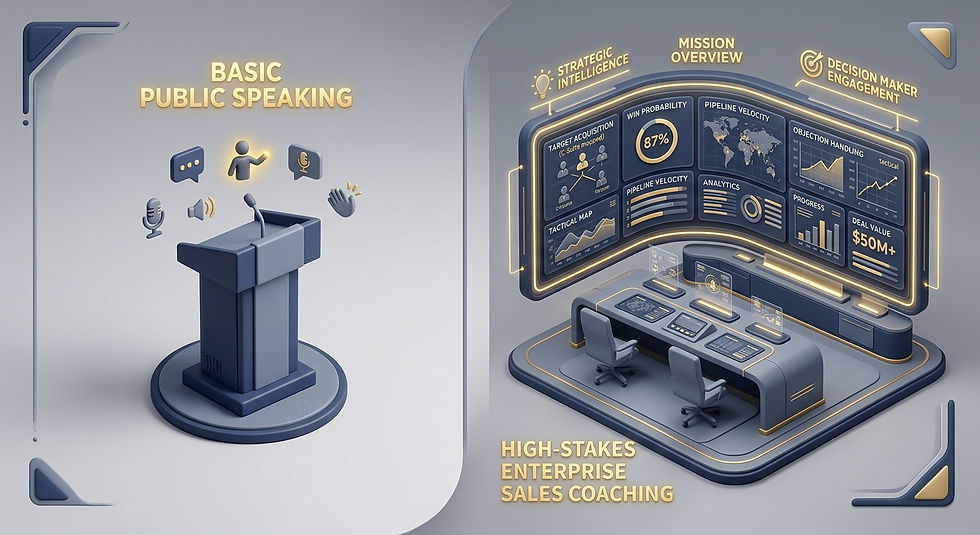
Standard Public Speaking Coaching vs. High Stakes Enterprise Sales Pitch Coaching
Most sales organizations invest in the wrong type of training for enterprise level presentations. Here is exactly what the difference looks like and why it matters.
Standard Public Speaking Coaching | High Stakes Enterprise Sales Pitch Coaching | |
Primary focus | Delivery comfort and structure | C-suite buyer psychology and deal closure |
Audience understanding | General audience engagement | Strategic Buying Committee dynamics and executive decision frameworks |
Pressure simulation | Low to moderate | Boardroom replication war room conditions |
Nervous system training | Basic confidence building | Military grade composure regulation under real challenge |
Content framework | Story structure and clarity | Business case framing, ROI architecture, risk reframing |
Q&A preparation | General objection handling | C-suite hostile Q&A, competitive challenge, and silence navigation |
Feedback mechanism | Session based verbal feedback | Live video pitch audit with frame level behavioral analysis |
Success metric | Audience approval and delivery quality | Deal conversion rate, sales cycle reduction, C-suite access rate |
Application context | Any professional presentation | 7-figure enterprise deals, board presentations, investor pitches |
Coach background required | Presentation experience | Real leadership under pressure + deep C-suite buyer psychology |
The gap between these two columns is not a gap in delivery skills. It is a gap in outcomes. And for enterprise sales teams competing for 7-figure deals in strategic buying committees, that gap is measured in revenue not satisfaction scores.
The full framework for executive presentation skills at the highest level: Executive Presentation Coaching Command Any Room →
Global Coaching Programs for Enterprise Sales Teams
Drawing from my 20-year background at sea serving as a Deck Officer, earning my Master Mariner License, and leading training at Royal Caribbean and CSMART Carnival Corp. I now bring those high stakes leadership frameworks directly to enterprise sales teams.
Our Executive Coaching Framework The Coach Who Brings the Boardroom Into the Training Room
As a Former Naval Commander and Executive Communication Coach, I work with enterprise sales teams, AEs, and CROs across Europe, the Middle East, and beyond.
My HALO System is built on a core insight: enterprise pitches don't fail because of content they fail when presenters lose executive peer status under pressure.
The 4 Dimensions of the HALO System:
How You Think: Train mental clarity to stay grounded when CFOs or CTOs challenge your model.
How You Speak: Frame recommendations around risk, return, and business outcomes instead of product features.
How You Move: Build vocal authority and composure signals that command the room before you share a single slide.
How You Connect: Read Strategic Buying Committees in real time to resolve unspoken C-suite concerns.

Enterprise Sales Presentation Coaching Programs
1-on-1 Executive Sales Presentation Coaching: Personalized, private coaching for individual Account Executives, Sales Directors, or CROs preparing for a specific high stakes pitch or building the executive presence skills for sustained deal performance at the highest level.
Virtual Global Workshops: Live, interactive workshops for enterprise sales teams delivered online designed for organizations with distributed sales forces across time zones, enabling consistent, scalable development without the cost or disruption of global travel.
Onsite Sales Presentation Bootcamps: Intensive, immersive programs delivered on location where entire sales teams move through live pitch simulation, video audit, peer review, and coached iteration over one to three days. Designed for sales kickoffs, strategic pitch preparation, and organizations pursuing a measurable uplift in enterprise deal conversion.
All programs include the signature live video pitch audit the component that produces the fastest and most durable behavioral change in AE presentation performance.
Explore the full suite of corporate leadership and sales communication programs: Corporate Leadership Coaching for Companies →
How the HALO System Transforms AEs Into Executive Peers
Here is what the transformation actually looks like in specific, behavioral terms.
Before HALO System coaching, a typical enterprise AE in a C-suite presentation:
Opens with company background and agenda slides
Presents features before connecting them to the buyer's specific business priorities
Slows when challenged, either over explaining or under committing
Treats Q&A as a test to survive rather than an opportunity to demonstrate strategic thinking
Closes weakly, leaving the next step undefined or dependent on the buyer to drive
After HALO System coaching, the same AE:
Opens with the business consequence of inaction connecting to the exact pressure the C-suite is currently managing
Frames every capability as an outcome mapped to the buyer's stated business priorities
Holds composure under hostile Q&A using the strategic pause, the confident acknowledgment, and the redirected answer to build rather than erode credibility
Uses silence as a leadership tool letting key points land before moving on, rather than filling every gap with defensive elaboration
Closes with a clear, specific call to action that the AE owns and drives
The difference is not in the slides. It is in the room's perception of who is leading the conversation.
Measuring the ROI of enterprise sales presentation coaching uses several key indicators: reduction in discounting frequency, improved conversion rate from initial meeting to VP/C-suite sponsor secured, and contraction in average sales cycle length. Tracking the percentage of deals with successful C-level stakeholder meetings also quantifies training effectiveness.
For AEs who want to develop the foundational speaking confidence that elite level pitch delivery requires: 7 Rules to Speak With Confidence →
The Voice in the Boardroom Why Vocal Authority Is a Sales Skill
There is one dimension of enterprise sales presentation coaching that almost no program addresses directly and one that I treat as a primary development priority: Vocal authority.
In a C-suite presentation, your voice is communicating your credibility before your content has had a chance to. The pace at which you speak signals whether you are in control or anxious. The pitch of your voice under challenge signals whether you are holding your conviction or quietly abandoning it. The quality of your pause signals whether you are a person who thinks before speaking or someone who speaks to avoid thinking.
Low status vocal signals are subtle but damaging: over explaining, rushing through points, asking permission to lead the conversation. Executives are wired to notice these cues and once they do, the dynamic is set. The damage is often done before the first slide appears.
The executives in that room have been in thousands of high stakes conversations. They read the voice the way a navigator reads a weather system automatically, accurately, and with immediate consequence for how the conversation proceeds.
Developing vocal authority for boardroom level sales presentations is not about sounding more impressive. It is about ensuring that the confidence you carry internally is the confidence the room perceives externally. The gap between those two things is exactly where deals are lost.
The complete framework for building vocal authority in high stakes presentations: Online Presentation Voice Training Master Virtual Vocal Presence →

FAQ: Enterprise Sales Presentation Coaching
Q: How long does executive presentation coaching for enterprise sales teams take?
The timeline depends on the starting point and the goal. Individual AEs preparing for a specific high stakes pitch can achieve meaningful behavioral shifts in two to three intensive sessions over one to two weeks. Full development of the composure, business case framing, and Q&A authority required for sustained 7-figure deal performance typically develops over six to twelve weeks of structured, progressive coaching. Organizations pursuing team wide capability uplift benefit most from a combination of intensive bootcamp delivery and ongoing coaching reinforcement.
Q: What is the ROI of C-suite pitch training for enterprise sales teams?
ROI is measured through reduction in discounting frequency, improved conversion from initial meeting to C-suite sponsor secured, contraction in average sales cycle length, and increased percentage of deals that reach successful C-level stakeholder alignment. Individual programs vary, but organizations that invest in structured executive sales presentation coaching consistently report measurable improvement across all four indicators within one to two full sales cycles. The cost of one lost 7-figure deal routinely exceeds the entire investment in team coaching.
Q: Can enterprise sales presentation coaching work for virtual pitches and remote presentations?
Yes and in 2026, it is an essential component of any comprehensive program. Virtual C-suite presentations carry additional complexity: the absence of physical presence, the compression of vocal signals through microphones and speakers, and the reduced feedback loop that makes reading the room significantly harder. My coaching programs include specific virtual pitch development addressing on camera presence, vocal authority through digital transmission, and the structural adaptations that boardroom level presentations require in hybrid and fully virtual formats.
Q: What makes my approach different from standard sales training?
Three core differentiators that standard programs do not offer:
Military-grade nervous system regulation: Built from twenty years of commanding naval vessels under genuine operational pressure not simulated scenarios.
C-suite buyer psychology: Applied directly at the deal level to decode exactly how economic buyers, technical evaluators, and internal champions think, what they fear, and what moves them from skeptical to committed.
Live video pitch auditing: Frame by frame feedback on actual performance at the precise moments where executive presence is won or lost.
The combination of these three, structured within our HALO System methodology, drives the behavioral change that directly impacts deal velocity and conversion.
The Boardroom Is the Final Exam. Most Sales Teams Are Walking in Unprepared.
Your enterprise sales team has worked too hard your organization has invested too much for the deal to die in the last room it visits.
The C-suite meeting is not a presentation. It is a trust transaction. The executives in that room are deciding whether the person in front of them is someone they can trust with their budget, their organization, and their reputation.
That decision is made in the first ninety seconds. It is confirmed or reversed in the Q&A.
And it is built, or not built, by everything the presenter has developed before they walk through the door.
IThe techniques I developed for maintaining command presence under genuine threat are the same ones I now apply in enterprise sales coaching adapted for the boardroom, not the bridge. And I have coached AEs in boardrooms with eighteen months of pipeline and seven figures on the table. The dynamic is identical. The room reads you before it hears you. Your job, in both situations, is to be exactly the person this moment requires not just to know the content, but to command it."
That is the transformation enterprise sales presentation coaching delivers.
Not a better deck. Not a cleaner script. A more commanding, more credible, more resilient presenter who belongs in every room they walk into and who the C-suite knows it.
Ready to Turn Your Enterprise Sales Team Into Boardroom Closers?
Whether you are a CRO building executive presence across a distributed sales force, a VP of Sales preparing a strategic account team for a critical 7-figure pitch, or an Account Executive who knows their boardroom performance is not yet matching their preparation the conversation starts here.
In thirty focused minutes, we identify exactly where your enterprise sales presentations are losing executive rooms they should be winning and the most direct coaching path to closing that gap before the next critical pitch.
As a Former Naval Commander, Executive Communication Coach, and Global Enterprise Sales Presentation Strategist with over 20 years of experience leading in high-pressure, multicultural environments, I work with Chief Revenue Officers, VPs of Sales, and enterprise Account Executives worldwide. Through my HALO System, a proven methodology for building executive presence, C-suite buyer alignment, and boardroom composure, I help sales teams close 7-figure deals.



Comments