
Executive Strategic Coaching The Methods, the Mindset, and the Global Programs That Actually Change How You Lead

"When I first stepped into leadership at sea, I assumed that knowing more than anyone else in the room was enough. It was not. The moment I understood that leading is communicating not informing everything changed. That is what executive strategic coaching builds." Marco Polito, Former Deck Officer to Master License, Award Winning Speaker, Executive Communication Coach
When I first stepped into leadership roles real ones, where decisions had real consequences, and the people around me were reading every signal I sent I quickly discovered something that no formal training had prepared me for.
Natural talent alone was not enough.
Not on a ship navigating degraded conditions. Not in a boardroom facing a skeptical CFO. Not in a team meeting where the culture you build in that room becomes the culture that defines everything that follows.
Leadership is a skill. A precise, learnable, coachable skill. And executive strategic coaching is the structured process through which that skill is developed at its highest level not through generic development programs designed for every leader simultaneously, but through a personalized, methodology driven engagement built around you, your specific challenges, and the exact gap between where you lead today and where your role is demanding you lead tomorrow.
The complete picture. What executive strategic coaching actually is. The methods that work and why. How the process unfolds in practice. And the global coaching programs that bring this development to leaders in New York, London, Dubai, Singapore, and everywhere in between.

What Is Executive Strategic Coaching?
Executive strategic coaching is a structured, one to one development engagement that helps senior leaders build the specific behaviors, communication authority, strategic thinking, and leadership presence that drive measurable business outcomes.
It is not mentoring where someone more experienced tells you what they did. It is not consulting where an expert tells you what to do. It is not training where a group learns the same framework simultaneously.
Executive strategic coaching is a precision instrument. It starts with your specific situation your team dynamics, your communication patterns, your leadership blind spots, your most pressing challenges and builds a targeted development pathway that produces behavioral change you can see in the room, feel in the conversation, and measure in the outcomes.
CHROs who treat coaching as a strategic lever rather than a transactional benefit create competitive advantage. The leaders who receive executive coaching aligned to specific business goals stakeholder management, communication authority, strategic decision making consistently outperform peers who receive generic development.
The "strategic" dimension in executive strategic coaching refers to two things simultaneously.
First, the coaching is aligned to your strategic business context not abstract leadership development, but development that is directly relevant to the decisions, stakeholders, and outcomes your role demands right now.
Second, it develops strategic leadership thinking the ability to see further, decide with greater clarity, and communicate your direction with the kind of conviction that makes organizations move.
Eight trends define executive coaching today. The most significant shift: specialized niche expertise is replacing generalist approaches. Leaders no longer want a coach who works with everyone. They want a coach whose methodology is built around the exact leadership challenge they are navigating.
This is exactly what the HALO System delivers.
Why Leadership Coaching Methods Matter More Than Leadership Advice
Here is the question worth asking before any coaching engagement: "What is the difference between receiving advice and developing a skill?"
Advice tells you what to do. A leadership coaching method trains you until you can do it automatically, under pressure, in the moments that matter most.
Modern leadership coaching practices highlight essential skills leaders must master: executive presence, strategic thinking, empathy, communication, and innovation. But the critical differentiator between coaching that produces lasting change and coaching that produces temporary insight is this: the method. How you structure the development process determines whether behavioral change sticks under real pressure or evaporates when conditions get difficult.
The leadership coaching methods that produce the strongest results share one quality: they focus on application, not information. They do not teach you about leadership. They develop you as a leader through real practice, expert observation, honest feedback, and repeated iteration until new behaviors become instinctive rather than effortful.
Here are the five core methods inside the HALO System and what each one actually does in practice.
The 5 Executive Strategic Coaching Methods That Build Real Leadership Authority
Method 1: Goal Oriented Strategic Alignment
Every executive coaching engagement starts with absolute clarity about what success looks like not in vague terms, but in specific, observable, measurable behavioral terms.
Not: "I want to be a better communicator."But: "In twelve weeks, I want to present to the board with enough authority that my recommendations drive decisions on the first presentation rather than requiring a second meeting."
That level of specificity changes everything. It gives the coaching a target. It gives you a benchmark. And it gives both of you a shared language for measuring whether the work is producing the change it is designed to produce.
The most effective leadership coaching programs combine peer accountability with goal aligned one to one coaching, creating a dual structure that drives both accountability and strategic clarity. When coaching objectives are tied to specific business outcomes rather than generic development goals, ROI becomes measurable and durable.
Method 2: Strengths Based Leadership Development
The most common mistake in leadership development and in most executive coaching programs is starting with weaknesses.
The assumption is that finding what is wrong and fixing it produces the strongest leader. The research says something different.
Strengths based approaches to executive development consistently outperform deficit focused models. Leaders who build on their existing strengths, leveraging what they do naturally well as the foundation for higher level performance, develop faster, retain skills longer, and demonstrate greater behavioral consistency under pressure than those whose development is framed primarily around correcting deficiencies.
This does not mean blind spots are ignored. It means they are addressed within a strengths framework using what you do well as the foundation for building what you need to develop. The result is development that feels natural rather than corrective, and that integrates into your genuine leadership identity rather than sitting alongside it as a performance.
Method 3: Reflective Practice With Expert Observation
Reflection is one of the most powerful and most consistently underpractised tools in leadership development.
Most leaders reflect in a general sense: "That meeting did not go well." Very few reflect with the kind of specificity that produces genuine learning: "The moment the CFO challenged my revenue assumption, my voice shifted in pitch, my pace accelerated, and I over explained for ninety seconds. That specific sequence is what I need to work on."
That level of precision requires two things: structured reflection frameworks and expert observation.
In executive strategic coaching, every significant leadership experience becomes a learning laboratory. You bring back what happened. The coach helps you analyse the specific moments the decision points, the communication choices, the behavioral signals that determined the outcome. And together, you build a refined approach for the next time that situation arises.
This method produces the compound effect that most leadership development programs cannot: every real experience becomes a coaching opportunity, which means your development does not pause between sessions; it accelerates.
Developing the coaching skills that make you a more reflective and impactful leader is the foundation of coaching skills for leaders →
Method 4: High Pressure Simulation and Role Play
Understanding how to handle a hostile boardroom question and actually handling it with composure, clarity, and the kind of authority that turns the challenge into a credibility building moment are two completely different things.
The gap between knowing and doing closes only through practice under conditions that closely replicate the actual pressure of the real moment.
This is the method I developed over twenty years at sea, where simulation was not a training preference it was a survival requirement. You practiced handling equipment failures before equipment failed. You drilled emergency procedures before emergencies happened. Because the nervous system does not perform well in situations it has never experienced.
In executive strategic coaching, this translates into structured simulations: boardroom Q&A drills with the hardest possible challenges. Difficult conversation role plays with the specific dynamics your team and stakeholders create. Presentation rehearsals under conditions that replicate the pressure of the real room including deliberate interruption, skeptical questioning, and the kind of silence that most presenters rush to fill.
A private equity portfolio company promoted a CFO to CEO. The coaching focused on stakeholder management, board communication, and strategic decision-making through simulation and real scenario rehearsal. She hit her first year EBITDA target and retained all critical executives. The simulation methodology practicing real situations before they happen was the component that transferred most directly into performance.
Method 5: Structured Feedback, Feedforward, and Video Audit
Feedback tells you what happened. Feedforward tells you what to do differently next time. The combination, when it is specific, honest, and delivered by someone who observed the real behavior rather than relying on self report, is the most efficient behavioral change mechanism available in leadership development.
In the HALO System, feedback is delivered in three forms.
In session observation: Live feedback during coaching exercises, focused on the specific moments where presence, communication, or composure is creating or losing authority.
Video audit: Recording practice presentations and real leadership moments, then reviewing them together to identify the gap between intention and impact. What you intend to communicate and what the room actually receives are often significantly different, and seeing that gap for yourself is more powerful than being told about it.
Feedforward planning: After each session, you leave with a specific behavioral commitment for the coming week not a general aspiration, but a precise action in a defined context. This creates the consistency of practice that builds habits rather than producing insight that fades before the next session.

How Executive Strategic Coaching Transforms Communication The Core Skill of Every Senior Leader
Communication is consistently identified as the single most critical leadership skill across every industry, role level, and geographic context. And it is the skill that degrades most visibly under pressure which is exactly when it matters most.
Here is what changes in how you communicate after a structured executive strategic coaching engagement in specific, behavioral terms.
Your opening commands attention instead of asking for it. You learn to lead with your recommendation, not your reasoning. With your conclusion, not your context. With the specific outcome the room needs to hear first, not the background that led you to it.
Your voice holds under challenge. When a skeptical stakeholder pushes back, your response comes from a place of grounded composure rather than defensive acceleration. The pause before your answer becomes an asset, not a gap to fill.
Your body language stops contradicting your message. The posture that signals uncertainty before you have said a word. The eye contact that drops to your notes exactly when it should be holding the CFO's gaze. The gestures that close inward when the room is skeptical. These patterns become visible and then they become choices, not defaults.
Your questions build rather than reveal gaps. The executive who asks powerful questions who steers a conversation through curiosity rather than assertion builds a different kind of authority than the one who fills every moment with their own perspective.
Your listening becomes a leadership tool. Active listening in executive contexts is not passive attention. It is the strategic gathering of the information that allows you to respond to what is actually being said, not to what you assumed would be said.
The complete communication framework for thought leadership and executive presentations is here: How to Create Thought Leadership Presentations for Executives →

Who Benefits Most From Executive Strategic Coaching and When
Most people who engage in executive coaching are at the C-suite level. The democratization of executive coaching means that managers, directors, VPs, and high potential professionals are accessing coaching support earlier in their careers when the investment has the longest compounding runway, and the behavioral change produces the most significant career trajectory impact.
Executive strategic coaching delivers the highest return at these specific career moments:
The leadership transition. Moving into a new role, whether a promotion, a company change, or a significant expansion of scope is the highest leverage moment for coaching investment. The behaviors and communication patterns you establish in the first ninety days of a new leadership role set the tone for everything that follows.
The performance plateau. When a leader with genuine capability is not advancing not because of what they do, but because of how they are perceived in the rooms that determine career trajectory, coaching addresses the exact gap that experience alone cannot close.
The high stakes preparation. A board presentation with $5 million on the line. An investor roadshow across three continents. A town hall where a difficult organizational message needs to land with trust rather than resistance. These moments call for specific, targeted coaching, not general development.
The enterprise sales team. Account executives and sales directors who present to C-suite buyers need a fundamentally different skill set from any standard sales training provides. Executive strategic coaching for enterprise sales teams develops the buyer psychology understanding, the boardroom composure, and the business case communication skills that close 7-figure deals.
See exactly how this applies to enterprise sales teams: Who Coaches Enterprise Sales Teams on Executive Level Presentations →
Building Leadership Habits That Last What Happens After the Coaching Engagement Ends
The most important question in any coaching investment is not "what happens during the sessions?" It is "what remains after they end?"
The HALO System is designed from the ground up to build habits not insights. The difference is critical.
An insight changes how you think. A habit changes how you behave automatically, under pressure, in the moments you cannot plan for.
Behavioral leadership assessment tools help leaders understand patterns, strengths, and development needs. But the tools are only as valuable as the application framework they are embedded in. Coaching that builds habits through repeated, structured practice followed by real world application and honest review produces leadership behavior that holds under the conditions that matter most: high stakes, real pressure, and real consequences.
Here is what habit formation looks like in practice:
Daily reflection: Five minutes at the end of each working day reviewing one leadership moment what happened, what you did, what you would do differently. This takes the learning out of the coaching session and puts it into the texture of real leadership life.
Weekly behavioral commitment: One specific behavioral change applied in one specific context not a general intention, but a precise action in a defined moment that you report back on in the next session.
Monthly progress review: A structured review of the behavioral change across the full month what is now natural that previously felt effortful, what still requires conscious attention, and what the next month's development priority should be.
This rhythm practice, application, review, refinement is what transforms executive strategic coaching from an experience into a permanent upgrade in how you lead.
Understanding the full landscape of what a leadership coach does in your career is here: The Role of a Leadership Coach in Your Career →

Marco Polito The Coaching Credentials That Make the Difference
What separates executive strategic coaching that genuinely changes behavior from programs that feel good in the room and fade within a month?
The answer is almost always the same: the coach's real world experience in high consequence environments.
Marco Polito brings credentials that no classroom trained coach can replicate:
20 years at sea from Deck Officer to Master, licensed as a Training Officer and Instructor. Real leadership, real pressure, real consequences for every communication and every decision.
4 major international organizations: AD Ports Group in the UAE, Royal Caribbean & Carnival Corporation, Grimaldi Group. Multinational, multicultural, high stakes leadership at scale.
Award winning speaker, Toastmasters International Division Level Winner. Keynote Speaker in Copenhagen, Istanbul, and Hamburg for IGGS.
2 published books on communication and career growth because the methodology is not just practiced; it is documented, tested, and refined.
This is not a coaching practice built on reading leadership research. It is a methodology built on living it and then spending two decades developing the frameworks that translate that experience into other leaders' growth.
"Real command, not theory" is not a tagline. It is the only standard this work is held to.
Empower Your Leadership Anywhere in the World
One of the most significant shifts in executive strategic coaching in 2026 is the elimination of geographic barriers. The leader in Dubai who needs to develop boardroom authority for a C-suite presentation next month does not need to wait for an in person program in London. The sales director in Singapore preparing for an enterprise pitch to a global strategic buying committee does not need to fly to New York.
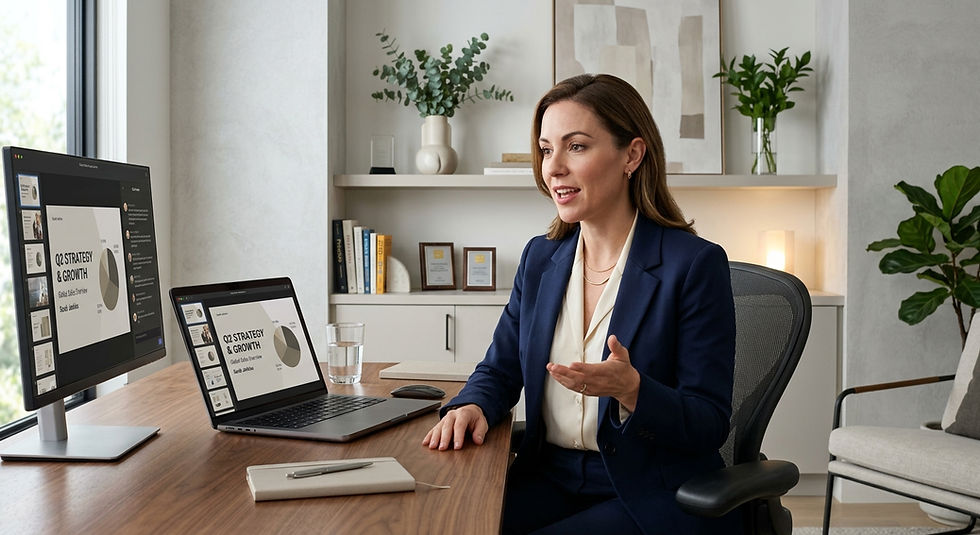
Whether you are based in New York, London, Dubai, or Singapore, our intensive virtual coaching programs are structured for international C-suite executives and managers who need high impact presentation and communication skills without geographic boundaries.
The virtual coaching experience Marco Polito delivers is not a downgrade from in person work. It is a deliberately designed online coaching environment with live video audit, structured feedback, and the same intensity and personalization of an in room engagement. Because the skills that matter in a boardroom are not different across geographies. The pressure is the same. The need for composure, clarity, and commanding authority is the same.
What changes is only the screen between coach and leader and that screen is not a barrier. It is an advantage. It means this development is available to you now, on your schedule, built around your actual calendar and your next real high stakes moment.
Digital first coaching delivery represents the most significant structural shift in executive development since the field began. Leaders access better coaches, more specialized expertise, and more flexible scheduling through virtual programs than most in person alternatives ever offered. The technology has caught up. The question now is not whether virtual coaching works it does but whether the coach's methodology is strong enough to deliver results through any medium.
The HALO System delivers results in every medium it has been applied in because the methodology is built around behavioral change, not environmental conditions.
FAQ: Executive Strategic Coaching
Q: What is executive strategic coaching?
Executive strategic coaching is a structured, one to one leadership development engagement that aligns personal leadership behavior development with specific strategic business outcomes. It differs from generic leadership training by being built entirely around the individual leader's situation, challenges, and goals producing behavioral change that holds under real pressure in real leadership contexts.
Q: What are the most effective leadership coaching methods?
The five methods with the strongest evidence base are: goal oriented strategic alignment (defining specific, measurable behavioral targets), strengths based development (building from what works rather than correcting what does not), reflective practice with expert observation (turning real experiences into structured learning), high pressure simulation (practising real scenarios before they happen), and structured feedback plus video audit (giving leaders an accurate picture of the gap between their intention and their impact).
Q: How does executive strategic coaching work in practice?
It begins with a discovery process to understand your specific leadership situation, blind spots, and the precise gap between your current performance and your role's demands. Development sessions then work on targeted skills through real practice and expert feedback. Between sessions, you apply what you are building in real leadership contexts. Progress is measured by behavioral change in specific high stakes situations, not by sessions attended or frameworks memorized.
Q: What is the ROI of executive strategic coaching?
Research on leadership coaching ROI consistently demonstrates returns of 3 to 7 times the investment when coaching is aligned to specific business goals and measured through behavioral change rather than satisfaction surveys. The metrics that best capture ROI are promotion rate, communication effectiveness in C-suite settings, deal conversion for enterprise sales roles, team performance under the coached leader, and reduction in costly communication failures at the executive level. The cost of one failed high stakes presentation or one derailed C-suite relationship routinely exceeds the entire investment in a structured coaching engagement.
Q: Can executive strategic coaching be delivered virtually for international leaders?
Yes and for most international leaders, virtual delivery is the most efficient format. Marco Polito's virtual programs are designed specifically for C-suite executives and senior managers who need intensive, high impact coaching without geographic constraints. Leaders in New York, London, Dubai, Singapore, and beyond receive the same methodology, the same intensity, and the same measurable outcomes as in room engagement.

The Room Has Always Been Waiting for the Leader You Are Becoming
Here is what I have learned across twenty years of leading at sea and two decades of coaching in boardrooms across continents.
The leaders who transform rooms, who change the quality of a meeting by walking into it, whose recommendations get approved because of who they are as much as what they propose, whose teams perform differently because of how they are led did not arrive that way.
They were developed. Deliberately, structurally, honestly.
Through coaching that asked more of them than comfort allowed. Through feedback that named what needed to change rather than celebrating what was already working. Through practice that put them in the pressure of the real moment before the real moment arrived.
That is executive strategic coaching at its best.
Not a program that makes you feel good about your leadership. A process that makes you genuinely better at it in the rooms that define your career, the conversations that build or erode trust, and the moments where the leader you have become is the only thing standing between a good outcome and a great one.
The room has always been waiting for that leader.
The coaching is how you get there faster.
Ready to Build Executive Presence That Leads From Anywhere in the World?
Whether you are a C-suite executive preparing for a high stakes board presentation, a director building the strategic communication skills your next level demands, or an organization seeking to develop leadership authority across a global team, the conversation starts here.
No obligation. No generic advice. A focused conversation about exactly where your leadership communication is leaving authority on the table and the most direct path to closing that gap before your next critical moment.
Intensive virtual and on site programs for international C-suite executives and management teams structured for high impact without geographic boundaries.


Comments